
Section outline

  • THEME

    Introduction to Artificial Intelligence for Weather and Climate Modelling

    DATES AND VENUE

    19–23 October 2026
    AIMS, Kigali, Rwanda

    PARTICIPATION

    44 participants

    From 21 countries

    ORGANISER

    African Centre of Meteorological Applications for Development (ACMAD)

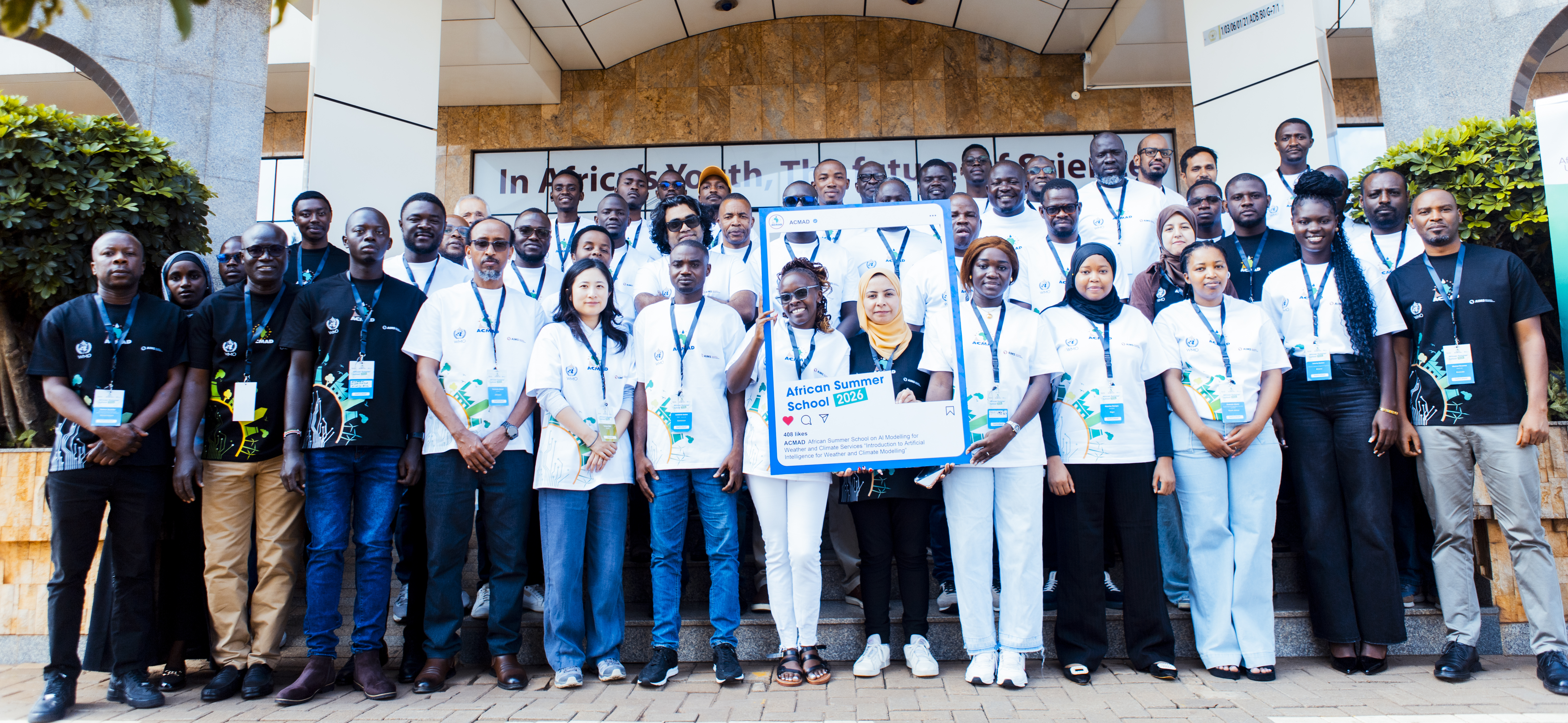
    Group photograph at the African Summer School 2026
    African Summer School 2026 · Kigali, Rwanda
    44 participants from 21 countries

    About the Summer School

    The African Summer School on Artificial Intelligence for Weather and Climate Modelling is an ACMAD capacity-development programme for African weather, climate, research and early-warning institutions.

    The 2026 edition took place from 19 to 23 October at AIMS in Kigali, Rwanda, bringing together 44 participants from 21 countries. It focused on foundational knowledge and practical skills in artificial intelligence for weather and climate modelling.

    Artificial intelligence and machine learning are emerging as complementary and, in some applications, surrogate approaches for weather forecasting, climate modelling, downscaling, bias correction, extreme-event detection and impact-based early warning.

    These approaches offer opportunities to complement numerical models, support forecast post-processing, improve local-scale information and develop practical applications where computing resources, specialised expertise and dense observational networks remain limited.

    The programme connected AI methods with African datasets and institutional needs, exploring how these methods can be evaluated, adapted and responsibly integrated into operational workflows.

    A Community of Practice established

    A Community of Practice (CoP) was established as an outcome of the Summer School to support continued collaboration and exchange on AI for weather and climate modelling.

    Overall purpose

    To strengthen Africa’s capacity to apply artificial intelligence in weather and climate modelling to improve climate information services, early warning and disaster risk reduction.

    Summer School objectives

    1. Understand

    Introduce the concepts and principles of AI and machine learning for weather and climate modelling.

    2. Connect

    Explain how AI can complement numerical prediction systems, climate models, observations and expert forecasting.

    3. Explore

    Examine applications in forecasting, bias correction, downscaling, nowcasting and extreme-event monitoring.

    4. Apply

    Provide hands-on experience with AI and machine-learning workflows using African weather and climate datasets.

    5. Evaluate

    Build the ability to assess model accuracy, bias, uncertainty, limitations and operational suitability.

    6. Collaborate

    Promote sustained collaboration among NMHSs, RCCs, universities, researchers and climate-service sectors.

    Learning outcomes

    The intended learning outcomes were to enable participants to:

    • Explain the role, opportunities and limitations of AI in weather and climate services.
    • Prepare weather and climate data for AI and machine-learning workflows.
    • Work with CSV, NetCDF and GRIB data using basic Python tools.
    • Describe applications in forecasting, bias correction, downscaling and early warning.
    • Develop and evaluate a simple AI-based example relevant to African services.
    • Prepare a practical institutional plan for applying the acquired knowledge.

    Learning approach

    The programme combined expert-led lectures, keynote sessions, hands-on coding workshops, peer learning and group project work, with African weather and climate datasets providing practical context.

    Expert lectures Keynote sessions Hands-on coding African datasets Group projects Peer learning

    Participants and representation

    44 participants · 21 countries

    Connecting African institutions through AI, weather and climate learning.

    The 2026 Summer School brought together participants from African institutions and programmes working across weather, climate, research and early-warning services.

    • National Meteorological and Hydrological Services
    • Regional Climate Centres
    • Universities and research institutions
    • Climate and early-warning organisations
    • Meteorology and climatology programmes
    • Hydrology and environmental science programmes
    • Computer science and data-science programmes
    • Relevant climate-sensitive sectors

    The selection approach prioritised gender balance, regional representation, early-career professionals and institutional relevance.

    Admission criteria for the 2026 edition

    • Affiliation with an NMHS, RCC, university, school, research institution or climate-related technical agency.
    • Background in meteorology, climatology, hydrology, computer science, data science, geography or a related field.
    • Basic Python knowledge or willingness to complete a pre-course Python module.
    • Demonstrated interest in AI applications for weather, climate or early-warning services.
    • Institutional support or a clear plan for applying the training.
    • Commitment to all sessions, practical exercises and group project activities.

    The admission approach encouraged participation by women and early-career professionals.

    Participation, outcomes and resources

    44 participants from 21 countries

    The Summer School brought together 44 participants from 21 countries for foundational and practical training in AI-enabled weather and climate modelling.

    Community of Practice established

    A Community of Practice (CoP) was established as an outcome of the Summer School, providing a platform for continued collaboration and exchange on AI for weather and climate modelling.

    Training resources

    Access presentations, notebooks and practical learning materials through the dedicated ACMAD eLearning training-materials course.

    Practical AI applications

    The programme’s practical component focused on examples relevant to African forecasting, climate modelling and early-warning services.

    Beyond the Summer School

    The established Community of Practice provides a basis for continued exchange among participants beyond the five-day programme.

    Follow-up priorities include sharing training resources, mentorship, continued development of participant projects and collaboration across institutions.

    Lessons from the 2026 edition will inform future themes and curricula, contributing to a sustained continental learning platform on AI for weather, climate and early-warning services.

    Access the training materials and practical resources for the African Summer School on AI for Weather and Climate Modelling.

    Access training materials →

    Sign-in and course access permissions may apply.

  • Day 1: 19/10/2026 Foundations and Context

    Time Session Lead and contributors
    08:30–09:00 Registration and participant networking Beathe
    09:00–10:30 1. Participants introductions — 30 minutes
    2. Programme — Patrick — 10 minutes
    3. AIMS Network President Prof. Sam Yala — 10 minutes
    4. DG ACMAD Dr. Ousmane Ndiaye — 10 minutes
    5. Photo — 15 minutes
    Bamba
    Rapporteur — Emmanuel Molou
    10:30–11:00 Health break  
    11:00–13:00 Keynote speakers: AI and ML — state of the art and the potential for Africa.
    1. Rich Turner: 11:00–11:45
    2. Pedram Hassanzadeh: 11:45–12:30
    3. Yuki Honda: 12:30–13:00
    Rendani
    Rapporteur — Mary Githutha
    13:00–14:00 Lunch break  
    14:00–15:30 Designing your weather/climate AI/ML experiment: data, model design and preventing data leakage Ehsan Bhuiyan
    Rapporteur — Adaman Yoda
    15:30–16:30 Opportunities, limitations, ethics and responsible AI use in the African context Chatterjee Dwaipayan
    Rapporteur — Amal Saber
    16:30–16:45 Health break  
    16:45–18:30 Open discussion  

    Day 2: 20/10/2026 Climate Data and Preparation

    Time Session Lead and contributors
    08:30–09:00 Day 1 recap — 10 minutes
    Official opening — DG METEO Rwanda Mr. Aimable Gahigi — 10 minutes
    Ousmane
    Rapporteur — Housseyni Sankare
    09:00–10:30 Introduction to xarray and reading in weather and climate data formats: CSV, NetCDF, GRIB, ZARR and related metadata Redouane
    Rapporteur — Coffi
    10:30–11:00 Health break  
    11:00–13:00 Hands-on Python data exploration: loading, inspecting and visualizing datasets Nishadh Kalladath
    Assistants: Ehsan Bhuiyan, Shruti, Nis
    13:00–14:00 Lunch break  
    14:00–15:30 Introduction to group practical: extreme event monitoring of atmospheric blocking systems Rendani
    Assistants: David Hogg, Shruti Nath, Ehsan Bhuiyan
    15:30–16:30 Group exercise: extreme event detection tasks using context guided segmentation Rendani
    Assistants: David Hogg, Shruti Nath, Ehsan Bhuiyan
    16:30–16:45 Health break  
    16:45–18:30 Open discussion  

    Day 3: 21/10/2026 Building an AI/ML Model

    Time Session Lead and contributors
    08:30–09:00 Recap and practical briefing Volunteer
    09:00–10:30 Introduction to global AI NWP architectures and similarities/differences to physical NWPs David Hogg
    Rapporteur — Thabisile Ntleko
    10:30–11:00 Health break  
    11:00–13:00 Hands-on practical/demo: Running a forecast from ECMWF using anemoi-inference and AIFS-single ECMWF Sara & Mariana
    Assistants: Nishadh Kalladath, Shruti Nath
    13:00–14:30
    • Skill decomposition and proper scoring. Hands-on practical: calculating the raw and calibrated skill of an AI NWP
    • Group project work: bias correcting outputs of 1 degree AI NWP towards IMERG
    Shruti
    Assistants: Mariana Clare, Sara Hahner, Rendani Mbuvha, Ehsan Bhuiyan
    14:30–15:15 Lunch break  
    15:15 Tour  

    Day 4: 22/10/2026 Evaluation and Application

    Time Session Lead and contributors
    08:30–09:00 Recap and review of group progress Volunteer
    09:00–10:30 Introduction to CAMulator Charlie Becker
    Rapporteur — Moussa
    10:30–11:00 Health break  
    11:00–13:00 Hands-on practical: generating predictions using CAMulator Charlie Becker
    Assistants: Sara Hahner, Mariana, Shruti Nath
    13:00–14:00 Lunch break  
    14:00–15:30 Introduction to building an Earth system model in anemoi Mariana & Sara
    Assistants: Nishadh Kalladath, Rendani Mbuvha
    Rapporteur — Nyaranga
    15:30–16:30 Group project refinement: limitations, responsible interpretation and preparation of presentations Shruti
    Assistants: Mariana Clare, Sara, Nishadh Kalladath
    16:30–16:45 Health break  
    16:45–18:30 Open discussion  

    Day 5: 23/10/2026 Demonstration and Institutional Uptake

    Time Session Lead and contributors
    08:30–09:00 Group preparation and submission of final project outputs Volunteer
    09:00–10:30 Group project presentations and technical feedback Shruti (Nishadh, Rendani)
    Rapporteur — Athanase
    10:30–11:00 Health break  
    11:00–13:00 Community of practice, mentorship arrangements and participant reflections and evaluation of the Summer School, certificate presentation and official closing Patrick
    Rapporteur — Hajara Kandeh
    13:00–13:30 Closing ceremony Ousmane
    13:30–14:30 Lunch break and departure