Introduction to Artificial Intelligence for Weather and Climate Modelling
DATES AND VENUE
19–23 October 2026 AIMS, Kigali, Rwanda
PARTICIPATION
44 participants
From 21 countries
ORGANISER
African Centre of Meteorological Applications for Development (ACMAD)
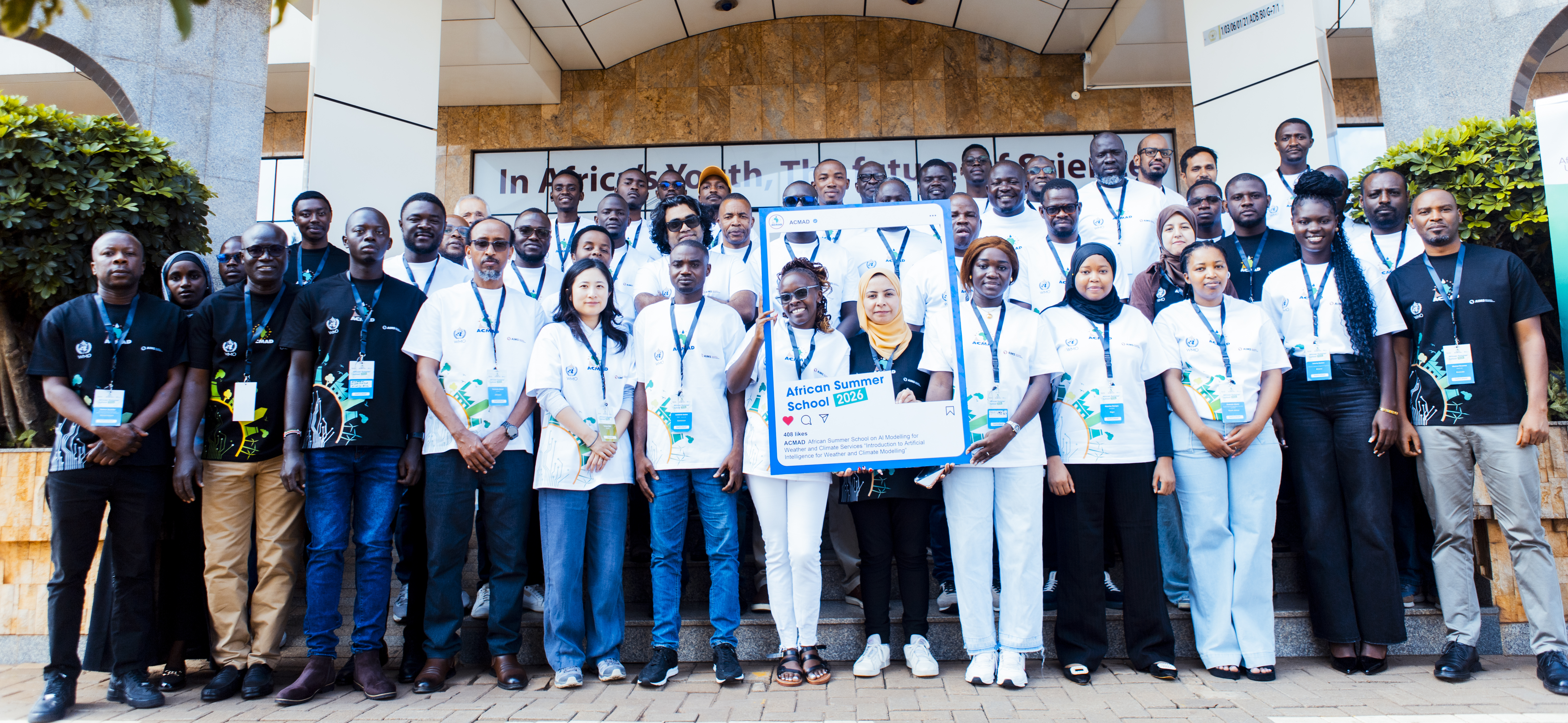
African Summer School 2026 · Kigali, Rwanda 44 participants from 21 countries
About the Summer School
The African Summer School on Artificial Intelligence for Weather and Climate Modelling is an ACMAD capacity-development programme for African weather, climate, research and early-warning institutions.
The 2026 edition took place from 19 to 23 October at AIMS in Kigali, Rwanda, bringing together 44 participants from 21 countries. It focused on foundational knowledge and practical skills in artificial intelligence for weather and climate modelling.
Artificial intelligence and machine learning are emerging as complementary and, in some applications, surrogate approaches for weather forecasting, climate modelling, downscaling, bias correction, extreme-event detection and impact-based early warning.
These approaches offer opportunities to complement numerical models, support forecast post-processing, improve local-scale information and develop practical applications where computing resources, specialised expertise and dense observational networks remain limited.
The programme connected AI methods with African datasets and institutional needs, exploring how these methods can be evaluated, adapted and responsibly integrated into operational workflows.
A Community of Practice established
A Community of Practice (CoP) was established as an outcome of the Summer School to support continued collaboration and exchange on AI for weather and climate modelling.
Overall purpose
To strengthen Africa’s capacity to apply artificial intelligence in weather and climate modelling to improve climate information services, early warning and disaster risk reduction.
Summer School objectives
1. Understand
Introduce the concepts and principles of AI and machine learning for weather and climate modelling.
2. Connect
Explain how AI can complement numerical prediction systems, climate models, observations and expert forecasting.
3. Explore
Examine applications in forecasting, bias correction, downscaling, nowcasting and extreme-event monitoring.
4. Apply
Provide hands-on experience with AI and machine-learning workflows using African weather and climate datasets.
5. Evaluate
Build the ability to assess model accuracy, bias, uncertainty, limitations and operational suitability.
6. Collaborate
Promote sustained collaboration among NMHSs, RCCs, universities, researchers and climate-service sectors.
Learning outcomes
The intended learning outcomes were to enable participants to:
Explain the role, opportunities and limitations of AI in weather and climate services.
Prepare weather and climate data for AI and machine-learning workflows.
Work with CSV, NetCDF and GRIB data using basic Python tools.
Describe applications in forecasting, bias correction, downscaling and early warning.
Develop and evaluate a simple AI-based example relevant to African services.
Prepare a practical institutional plan for applying the acquired knowledge.
Learning approach
The programme combined expert-led lectures, keynote sessions, hands-on coding workshops, peer learning and group project work, with African weather and climate datasets providing practical context.
Connecting African institutions through AI, weather and climate learning.
The 2026 Summer School brought together participants from African institutions and programmes working across weather, climate, research and early-warning services.
National Meteorological and Hydrological Services
Regional Climate Centres
Universities and research institutions
Climate and early-warning organisations
Meteorology and climatology programmes
Hydrology and environmental science programmes
Computer science and data-science programmes
Relevant climate-sensitive sectors
The selection approach prioritised gender balance, regional representation, early-career professionals and institutional relevance.
Admission criteria for the 2026 edition
Affiliation with an NMHS, RCC, university, school, research institution or climate-related technical agency.
Background in meteorology, climatology, hydrology, computer science, data science, geography or a related field.
Basic Python knowledge or willingness to complete a pre-course Python module.
Demonstrated interest in AI applications for weather, climate or early-warning services.
Institutional support or a clear plan for applying the training.
Commitment to all sessions, practical exercises and group project activities.
The admission approach encouraged participation by women and early-career professionals.
Participation, outcomes and resources
44 participants from 21 countries
The Summer School brought together 44 participants from 21 countries for foundational and practical training in AI-enabled weather and climate modelling.
Community of Practice established
A Community of Practice (CoP) was established as an outcome of the Summer School, providing a platform for continued collaboration and exchange on AI for weather and climate modelling.
Training resources
Access presentations, notebooks and practical learning materials through the dedicated ACMAD eLearning training-materials course.
Practical AI applications
The programme’s practical component focused on examples relevant to African forecasting, climate modelling and early-warning services.
Beyond the Summer School
The established Community of Practice provides a basis for continued exchange among participants beyond the five-day programme.
Follow-up priorities include sharing training resources, mentorship, continued development of participant projects and collaboration across institutions.
Lessons from the 2026 edition will inform future themes and curricula, contributing to a sustained continental learning platform on AI for weather, climate and early-warning services.
Access the training materials and practical resources for the African Summer School on AI for Weather and Climate Modelling.